
Receive orders
Controlled API, webhook or validated file intake after access is approved.
NaviBatch Enterprise
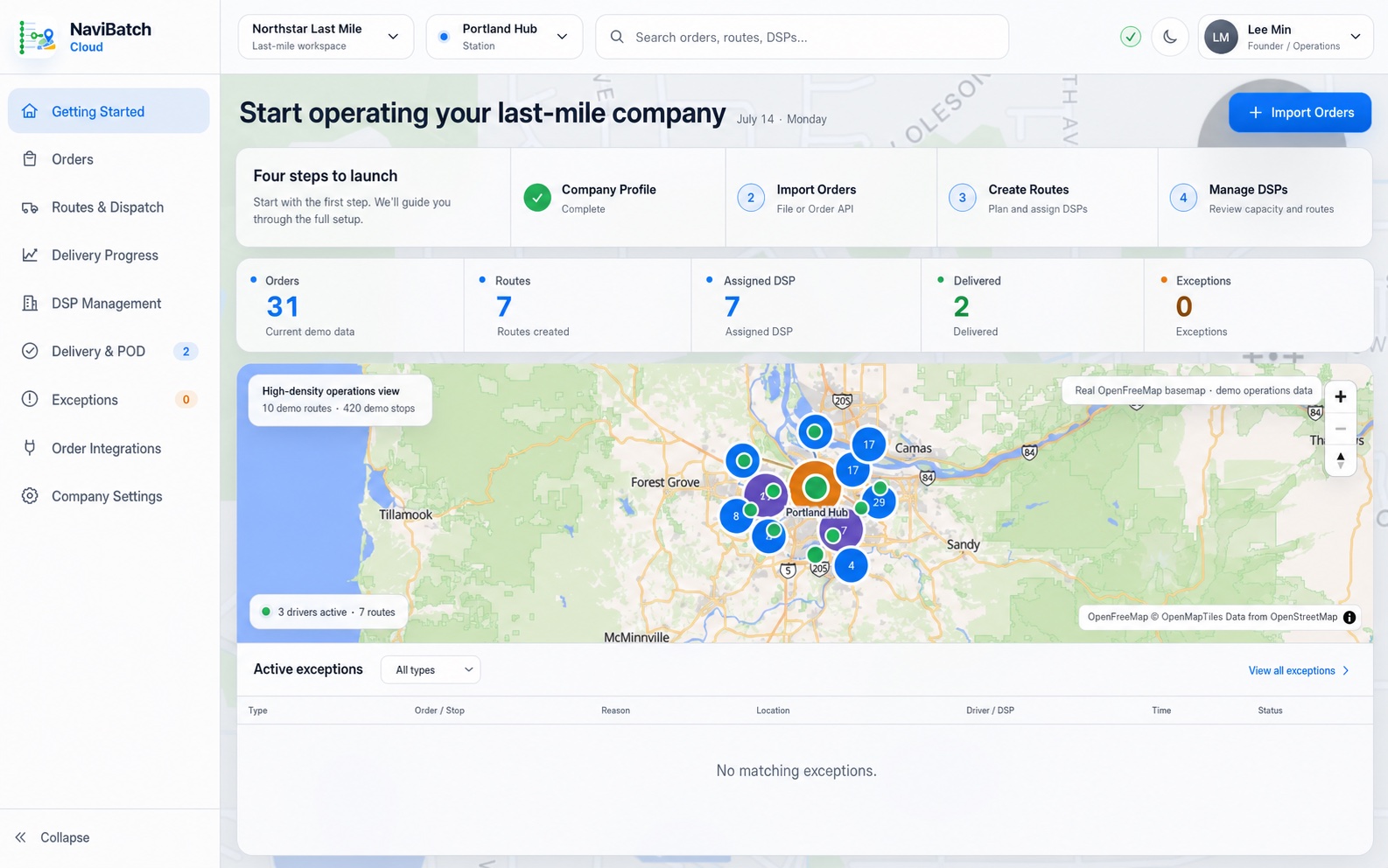
A pilot-stage operating layer for last-mile companies to receive orders, create routes, dispatch DSPs, follow delivery progress, and review POD and exceptions.
The demo is public staging with sample data. A production Portal will be a separate private environment with real identity, role and tenant controls.
Operating flow
The system follows the real operating handoffs between a commerce platform, a last-mile company, its DSP network and the driver execution layer.
Controlled API, webhook or validated file intake after access is approved.
Check order identifiers, addresses, tracking fields and required service rules.
Group work into operating routes and preserve the business context behind each task.
Send routes to the appropriate DSP organization with visible capacity and status.
Drivers scan, load, navigate, report results and submit required evidence.
Review POD and exceptions before approved events return upstream.
Clear responsibility
Each role sees the work it owns. The last-mile company governs the operation, the DSP dispatches its drivers, and drivers execute through the mobile workflow.
Receives orders, defines operating rules, creates routes, manages DSP relationships, monitors delivery progress, reviews POD and owns exception resolution.
Accepts assigned routes, manages its driver roster and assigns route work. DSP users do not approve company-level POD decisions.
Uses the mobile execution workspace for scanning, loading, route tasks, navigation, delivery results, POD capture and failed-delivery reporting.
Daily operations
The interface is designed for high-tempo operations: core status stays visible, complex actions open in focused sheets, and each module has a distinct operational purpose.
Review intake status, route creation, assignments and operational history.
Follow assigned drivers, delivered, failed, remaining and last-event status by route.
Review delivery evidence, identify incomplete proof and resolve operational exceptions.
Keep company rules, members, data controls and significant actions visible.
Order integrations
The architecture supports several controlled intake patterns. The correct path depends on platform approval, available credentials, field requirements and testing.
Map order, address, tracking and status fields after the platform provides authorized access. No official integration is claimed before verification.
Prepare a controlled merchant connection after the store owner authorizes the required API and webhook scope.
Use validated CSV, JSON, SFTP or signed webhook workflows when a direct platform API is unavailable.
NaviBatch is an independent technology provider. References to commerce platforms, merchants or courier workflows do not imply affiliation, partnership, guaranteed access or an available production connector.
Data and reliability
A production Portal must enforce identity and tenant boundaries at the API, database and object-storage layers—not only in the browser interface.
For last-mile founders
Someone who has delivered large volumes or managed a DSP already understands drivers, loading and field operations. NaviBatch is designed to remove the need to build the complete technical foundation alone.
Early partner model: for selected pilot partners, NaviBatch plans to carry the initial system development and deployment work. Pilot scope and later commercial terms are agreed case by case.
Common questions
Clear boundaries make the product easier to evaluate and prevent a staging demonstration from being mistaken for a production operation.
No. This page is public product information. The private Portal is a separate product environment that must use real authentication, role permissions and tenant isolation. The current public demo contains only fictional test data.
It is designed around controlled API, webhook and file-based intake. Every production connection still requires credentials, field mapping, technical testing and approval from the relevant platform or merchant.
No. A DSP can manage its drivers and route assignments, but company-level POD review and exception policy remain with the last-mile company.
No. It is staging software for evaluating workflows with sample data. Production launch still requires real identity, security validation, live integration acceptance, monitoring, automated backups and tested recovery.
No. NaviBatch provides technology. Order contracts and financing remain commercial responsibilities of the last-mile operator and its partners.
Review the public staging demo, then talk with NaviBatch about a controlled pilot for your last-mile operating model.